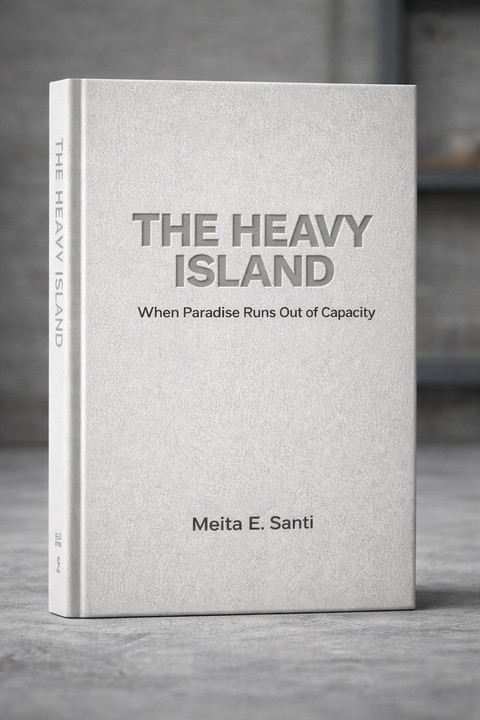
When Paradise Runs Out of Capacity
This book does not treat Bali as a place under threat. Bali has enough visibility, enough data, and enough daily density. The condition it reveals is one other destinations will eventually need language for.
That condition is tourism-heavy: a state in which tourism stops sitting alongside everyday life and begins pulling on many parts of it at once. Roads, waste, land, price, identity. Not a crisis. Not collapse. Something more specific and more useful to name: a place carrying more than it was designed to hold, and doing so quietly enough that the weight has started passing for normal.
Bali has always had a way of pulling people in. The island still delivers ease, beauty, and the brief feeling of being released from tighter rhythms elsewhere. The book reads what that ease now costs, and finds language for pressure before it becomes harder to reverse.
The argument begins at a four-way intersection. A time when moments like that did not seem worth remembering. Motorbikes arriving from different directions, a car inching forward, someone slowing down, someone else waving the other through. What changed was not the presence of traffic. What changed was the social margin inside the encounter.
Read Preface Free to ReadThirteen terms the book builds and uses throughout. Each one does specific work that existing vocabulary does not cover. Tourism-Heavy, Bali 1.0, Peak Bali, the Five-Indicator Map, Commons, the Pedestrian Test, the Tuesday Test, Quality Pivot, Working Island, Normal, Usual, Lived Identity, Performed Identity, Outdated.
Read GlossaryI did not begin writing this book because of a policy debate or a headline. I began writing it because of a four-way intersection.
There was a time when moments like that did not seem important enough to remember. A few motorbikes arriving from different directions, a car inching forward, someone slowing down, someone else waving the other through. Nothing elegant or ideal. But it worked because people were still willing to give each other a few seconds. That was the part that mattered. The road did not move smoothly because it was well designed. It moved because, in hundreds of small encounters, people were still prepared to yield twenty seconds so that everyone could continue.
At some point, that stopped feeling true.
What changed was not the presence of traffic. Bali has had busy roads for a long time. What changed was the social margin inside the encounter. People no longer seemed willing to surrender those twenty seconds. Everyone edged forward a little sooner. Everyone guarded the opening in front of them a little more carefully. The whole exchange became tighter, less forgiving, more deliberate. Nobody needed to say anything for the shift to be clear. It was visible in posture, in timing, in the disappearance of hesitation. Waiting no longer felt shared. The road had become a place where people were not simply moving through space. They were protecting their turn inside a setting that no longer inspired much trust.
∗ ∗ ∗That was when I began paying closer attention. Once you notice that kind of change, you start seeing it elsewhere. Not the same scene repeated, but the same condition appearing through other parts of daily life. Ordinary things begin asking for more calculation than they should. A small errand depends on timing, anticipation, and luck. The day feels less open. The margin for error narrows. Bali is still functioning, still admired, still full of energy and attraction, yet doing so with a different kind of effort underneath.
That effort is easy to miss if Bali is read only through its most marketable surface. Beauty is still here. Desire is still here. Arrival is still here. People still come with longing, businesses still expand, villas still rise, tables still turn, and images still circulate with extraordinary force. None of this is false. Yet none of it answers the harder question of what it now costs to keep ordinary life moving. A place can remain outwardly successful while becoming steadily more demanding in the lived sense. That is one reason the deeper change can continue for so long without being named properly.
In the roadside pauses, you can feel the difference.
∗ ∗ ∗A place under sustained pressure does not always announce itself through breakdown. More often, the change appears in the thinning out of small acts of accommodation. Those acts are rarely noticed when they are still abundant. They are part of what allows a place to feel workable. They give daily life room to breathe. Once they begin to disappear, the loss is no longer symbolic. Roads grow harsher. Timing grows tighter. People become more guarded with their energy, their attention, and their patience. This is how adaptation leaves its mark: not in declarations, but in ordinary practice.
On an island, that process is difficult to hide for long. Limits are felt more directly. Distance behaves differently. Development does not spread without consequence. Intensified use moves quickly through roads, housing, services, prices, and public tolerance. A longer journey home, a narrower lane between new walls, a familiar shortcut that no longer saves time. Pressure enters the day in practical ways. It alters how movement is arranged, how much forethought ordinary life requires, and how much effort is needed to do what once felt simple.
∗ ∗ ∗No single complaint explains that condition. Every fast-growing destination has its familiar grievances. Roads are crowded. Prices rise. Waste accumulates. Space narrows. Any one of those can be dismissed. What is harder to dismiss is the pattern emerging when these pressures stop appearing separately and begin shaping one another. At that point, they no longer describe scattered inconveniences. They describe a place carrying more intensity than its underlying arrangements can comfortably hold.
That is the condition I have tried to name in these pages. I call it tourism-heavy. Weight changes tempo, cost, and tolerance. It changes what people can absorb without visibly breaking. A tourism-heavy island may still be beautiful, prosperous, and desirable. But the weight is carried somewhere, and eventually it begins to alter the practical terms on which ordinary life continues.
Bali is often discussed as an image, a destination, an economy, an aspiration, or a cultural symbol. It is all of those things. But it is also a working island, a lived island, and a place whose daily operation reveals more than its branding ever can. The road is part of that revelation. The housing market is part of it. So is the changing use of land, and the tightening feel of moving through spaces that once offered more ease. These are not side notes to the story. They are the story, or at least the beginning of it.
∗ ∗ ∗I wrote this book to understand what happens when a place remains admired and productive while becoming less generous in the texture of ordinary life. I wanted language for pressure before it becomes collapse, and for structural change before it is reduced to mood or complaint.
The everyday turned out to be the clearest evidence. That is where the deeper arrangement of a place becomes legible.
For me, that attention began at an intersection, in the realization that people were no longer willing to give each other twenty seconds. That seemed minor at first. It no longer does. When a place can no longer spare twenty seconds of mutual accommodation without turning it into a contest, something important has shifted. The change may not yet have the drama of crisis, but it already has the texture of strain. Once that texture becomes visible, it is difficult to stop seeing it everywhere.
"The behavior of a system cannot be known just by knowing the elements of which the system is made."
Donella Meadows
Thirteen terms developed throughout the argument. Each one does work that existing vocabulary does not, naming a condition, a test, or a distinction the book depends on.
A condition in which tourism stops sitting alongside everyday life and begins pulling on many parts of it at once: movement, waste, space, price, identity, and the daily systems that hold them together.
The earlier operating logic of Bali's tourism economy: cheap, flexible, improvisational, and buffered by more room, more tolerance, and more informal workaround than the present island can comfortably sustain.
The point at which tourism intensity presses against multiple kinds of capacity at once without requiring dramatic collapse in one obvious place.
The book's working map of the condition: movement, waste, space, price, and identity. Not a scorecard but a lens for noticing where the island begins carrying more than it once did.
Shared room that remains usable without requiring purchase, frontage privilege, or soft exclusion. The commons is what tourism-heavy conditions erode first.
A way of asking whether a place still allows short distance to behave like short distance. Whether someone can walk five hundred metres without the route collapsing into interruption or risk.
A way of testing whether ordinary life works on an ordinary weekday without excessive workaround. Not during a summit or a ceremonial showcase. On a normal day when people are going to work, moving goods, crossing short distances, trying to get home.
The move from volume logic to capacity logic. From counting more to asking what the island can responsibly carry. A pivot is real when the island becomes more workable in ways people can feel without being told that progress is happening.
An island that allows movement, waste handling, shared space, nearness, and recovery to function with more clarity and less hidden burden. The Bali that sustains the Bali in the photographs.
In this book, not what people have grown used to, but what should still work without unusual effort. The book distinguishes this from what has become usual in order to resist granting legitimacy to repeated dysfunction.
Identity sustained through ordinary participation, proximity, and repeatable life, not only through display or symbolism. What makes a place broadly livable rather than merely legible to outsiders.
Identity that remains visible and legible even when the conditions that make it broadly livable have thinned. What a place presents to visitors while residents absorb the gap between image and daily reality.
The standard by which the book hopes to be judged: less necessary because the island has genuinely begun to function better. This book is written to become outdated. That hope is practical.
The central diagnostic term introduced. Tourism-heavy is not a label meant to blame people for coming. It is a diagnosis of a condition. A place can remain desirable and overloaded at the same time. For quite a while, both truths can stand together.
The operating system that made Bali feel easy for a very long time. Not nostalgia. A way of naming defaults. Some things get prioritized. Some get postponed. Rules bend in practice. And what works once has a way of becoming normal.
Peak is not collapse. The island does not suddenly stop functioning. What changes is the amount of room left to absorb what success keeps asking of it. Roads no longer clear as easily. Waste lingers longer. Housing bends more quickly toward visitor demand.
Normalization of deviance, place myth, and behavioural adaptation. How workaround, blur, and tolerated strain become misread as atmosphere, authenticity, or even local wisdom. What visitors felt as atmosphere was often hidden labour, hidden adjustment, and hidden tolerance doing more work than anyone had named clearly.
Roads carry more than visitors. They carry workers, deliveries, construction, ordinary errands. As tourism grows, these flows press more often against the same corridors. A short trip starts needing timing. Distance matters less than the hour. Congestion as a system invoice, not a nuisance.
Waste treated as a truth-teller. It reveals whether the island can metabolize what it produces. Not only quantity but the rhythm at which materials move through the same chain. When turnover accelerates, even workable arrangements begin falling slightly behind.
Space rarely changes all at once. One plot at a time. A house becomes a guesthouse, a field becomes a cafe, a quiet lane becomes a corridor. Commons erosion, land-use change, and the horizontal expansion trap. A place can remain visually attractive while becoming less available as shared room.
The land-value spiral and the way tourism-linked price systems become social sorting systems. Rising price changes who remains near ordinary life and who is pushed into time-consuming distance. Workers travel farther. Price may appear economic on the surface, yet it gradually redraws the social map.
Identity treated as an operating condition, not a slogan. A place known globally must continually interpret itself to an outside audience while still remaining livable from within. The lived/performed distinction and what happens when the two begin to diverge permanently.
The move from volume logic to capacity logic. Not a branding exercise, not conference language, not a vision slide. A pivot becomes meaningless the moment it stays rhetorical. It has to enter daily life in visible standards. A person should be able to feel the difference.
A working island is not proved by its best moments. It is proved by whether a Tuesday remains manageable without asking too much hidden effort from the people living inside it. Move, clean, share, stay, recover. Not utopia. A raised floor beneath the ordinary day.
Normalization reversal. The distinction between the usual and the normal. How people become skilled at carrying a bad baseline. A safe short walk should not be a premium experience. Waste leaving on time should not be treated as a breakthrough. Public room without purchase should not sound like a policy dream.
This book is written to become outdated. That hope is practical. Systems change, and when they do, the language once used to describe strain should begin to feel slightly wrong. How would people know the old diagnosis was losing force? Not a grand solution. A raised floor beneath the day.
When a place can no longer spare
twenty seconds
without turning it
into a contest.